
Where Power Converges
How a single network of donors, consultants, and insiders positioned itself at the intersection of public money, policy, and political influence in Oklahoma.

If you’ve been following this series, you already understand the consultant network. You’ve seen how the same firms, the same PACs, and the same compliance structures show up across campaigns. That part isn’t new. What is new is how far that network actually reaches.
This is no longer just about campaigns. It touches policy. It touches public money. And it touches who is sitting in positions where decisions get made. Once you start putting those pieces together, the picture changes.
The Legislative Foundation
Start with the policy side. SB 1447 helped reshape how Oklahoma handles economic development, and out of that framework came structures like OkEdge and the LEADS Committee. These are not background entities. They sit close to where decisions are made about which companies receive incentives and which projects move forward. That proximity matters, because those decisions involve real money.
OkEdge is state-created economic development entity within the Department of Commerce. It was established under Oklahoma law to identify, evaluate, and advance strategic business and infrastructure opportunities that drive statewide growth. it is meant to function as a quasi public private vehicle that works alongside legislative leadership and advisory bodies like LEADS.
LEADS or the Legislative Economic Advancement and Development Structure is a legislative body created by the same bill SB1447 to review, shape, and advance major economic development proposals and incentive packages. LEADS in practice was meant to be a critical point where major deals are discussed, incentives are weighed and legislative support is aligned.
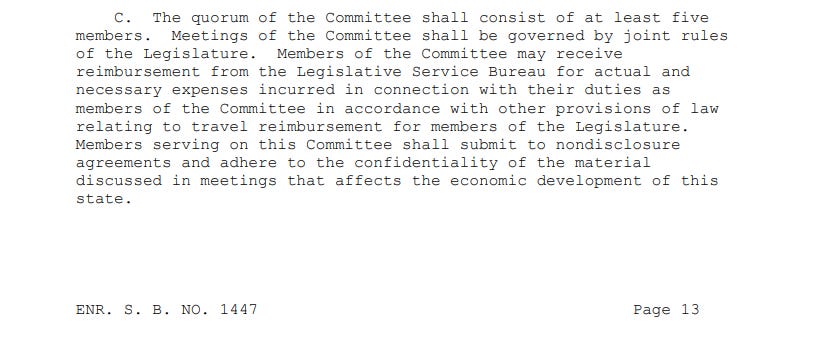
A critical part of this and potentially the most controversial of this bill is found in Section 8, Subsection C. Under this provision, the members of the LEADS Committee are required to be under a Nondisclosure Agreement.
Money Begins to Move
At the same time those structures are in place, the state begins moving large amounts of federal funding through the system. On January 25, 2024, the Oklahoma Broadband Office approved 142 projects under ARPA and SLFRF. Among those approvals were multiple awards tied to Hilliary Communications through affiliated entities: Southern Plains Cable received $17,274,465.69, Oklahoma Western Telephone Company received $3,930,025.00, and Southwest Oklahoma Telephone Company received $2,607,794.51. That is a combined total of roughly $23.8 million across those entities.
But that was not the full picture. In the final approval published by the Oklahoma Broadband Office, Hilliary Communications was set to receive $43.2 million in total funding, with the company expected to match an additional $22.8 million. That brings the total project footprint to more than $66 million tied to a single network of companies.
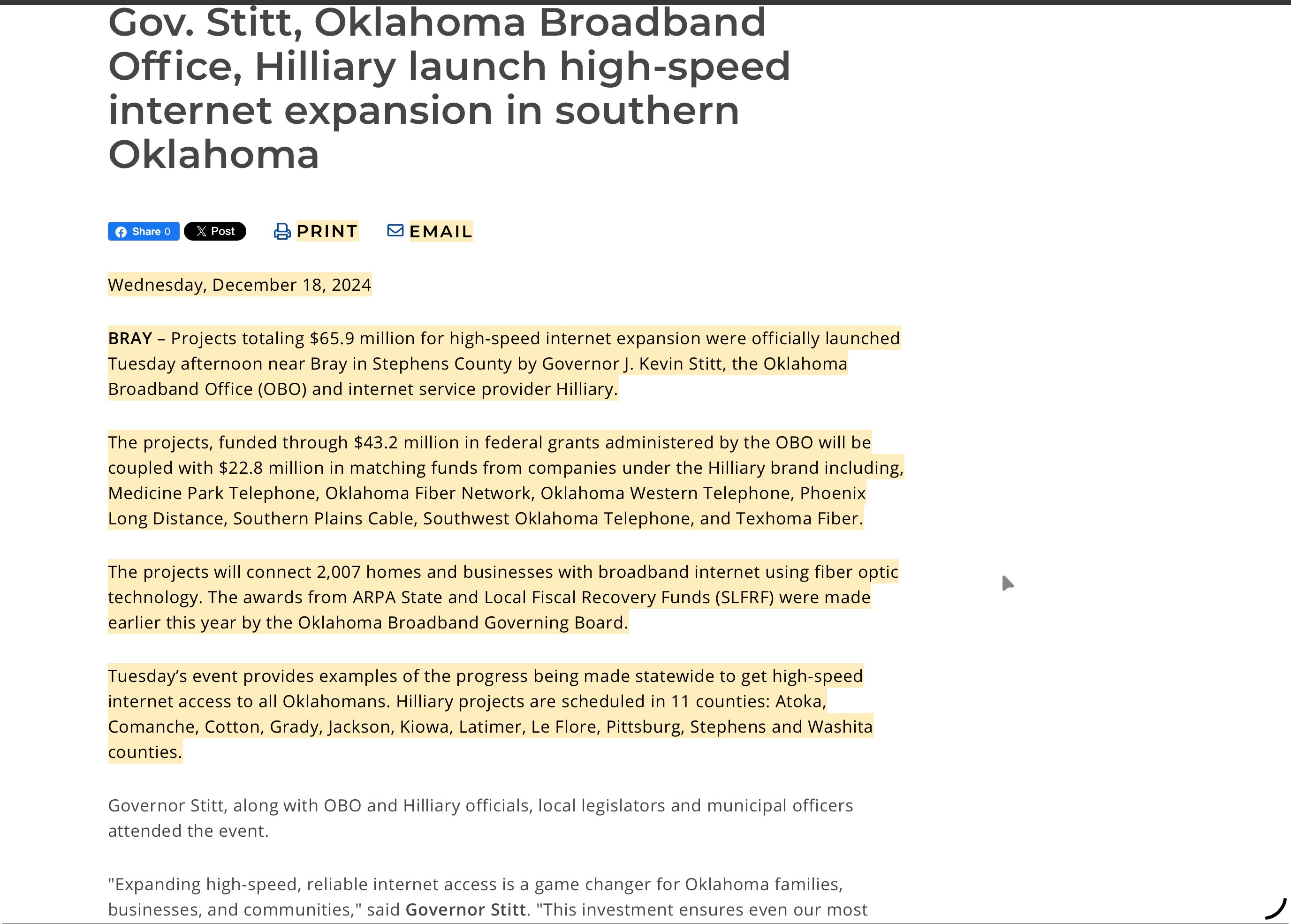
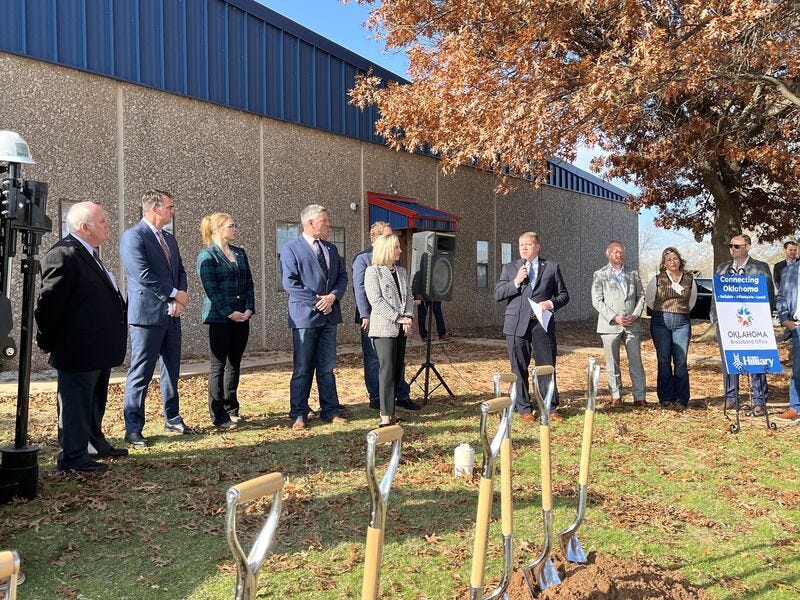
Then on December 17, 2024, there was a public event in Marlow. The Governor’s office stood alongside the Oklahoma Broadband Office to formally launch that funding. This was not a quiet administrative action. It was a visible moment that placed a private company at the center of a major taxpayer-funded investment.
It also matters that this is not purely state money. This is ARPA funding, federal dollars moving from Washington through the state and into private infrastructure. When federal money enters a system, the stakes change. The visibility changes. And often, the level of political interest changes with it. That raises a question that sits just outside the documents. Why would a national-level PAC like Defend US be so active in Oklahoma?
On its face, that activity shows up as independent expenditures, media spending, and involvement in key races. But when viewed alongside the movement of tens of millions in federal dollars through state-controlled programs, it begins to look less random. Not as a conclusion, but as a possibility. That larger financial landscape may help explain why outside political infrastructure appears so engaged in what might otherwise be considered local races.
Random Donations or Donations with a Purpose
Now step back and look at what came before it. In the months leading up to April 1, 2022, members of the Hilliary family and senior leadership within Hilliary Communications made a cluster of political donations. These were not isolated contributions. They came from individuals tied to the same company and the same network. Shortly after, Dustin Hilliary was appointed to the Oklahoma Board of Regents. What is interesting about this appointment was Dustin at the time did not hold any college degree or credentials normally present within the Board.
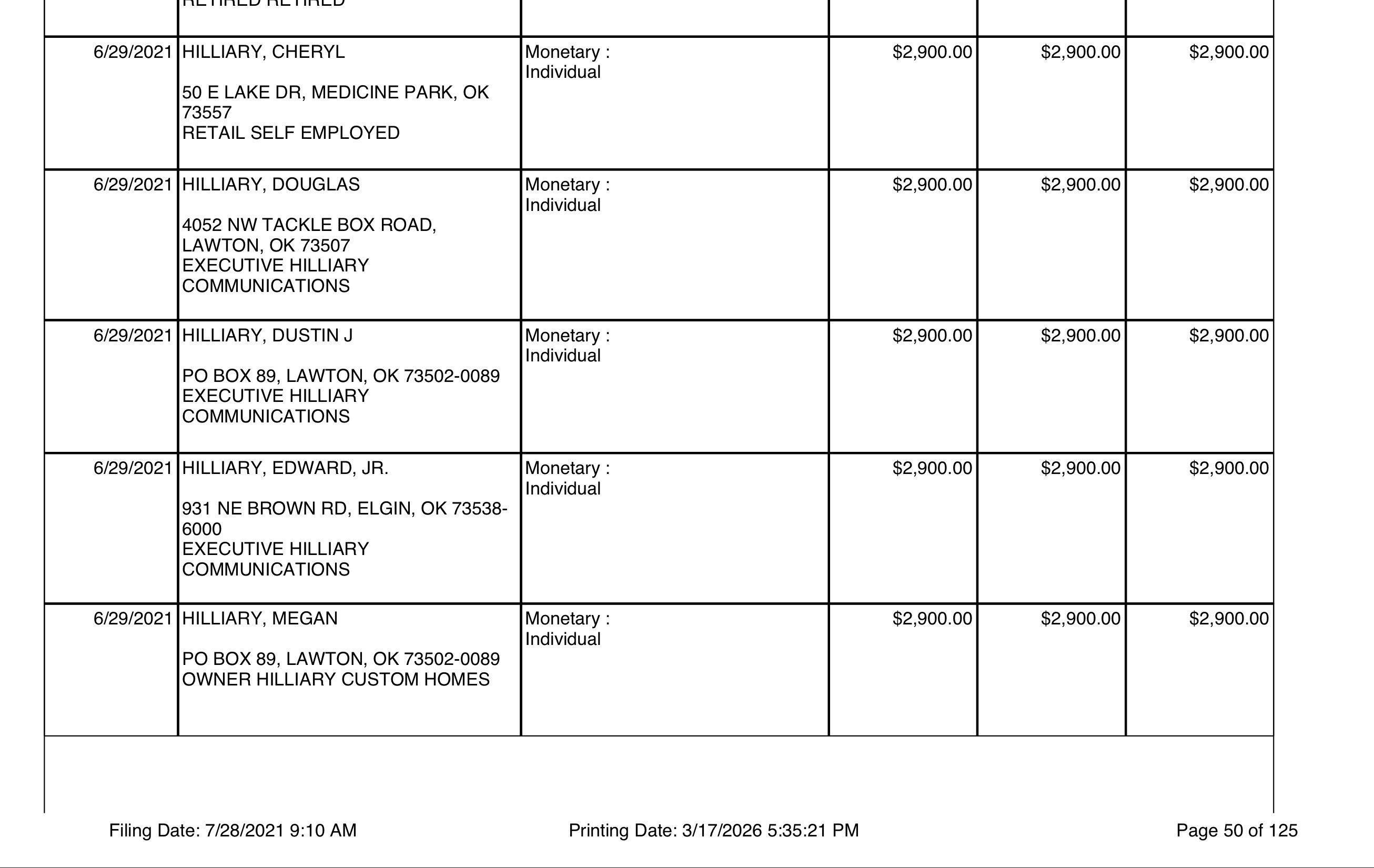
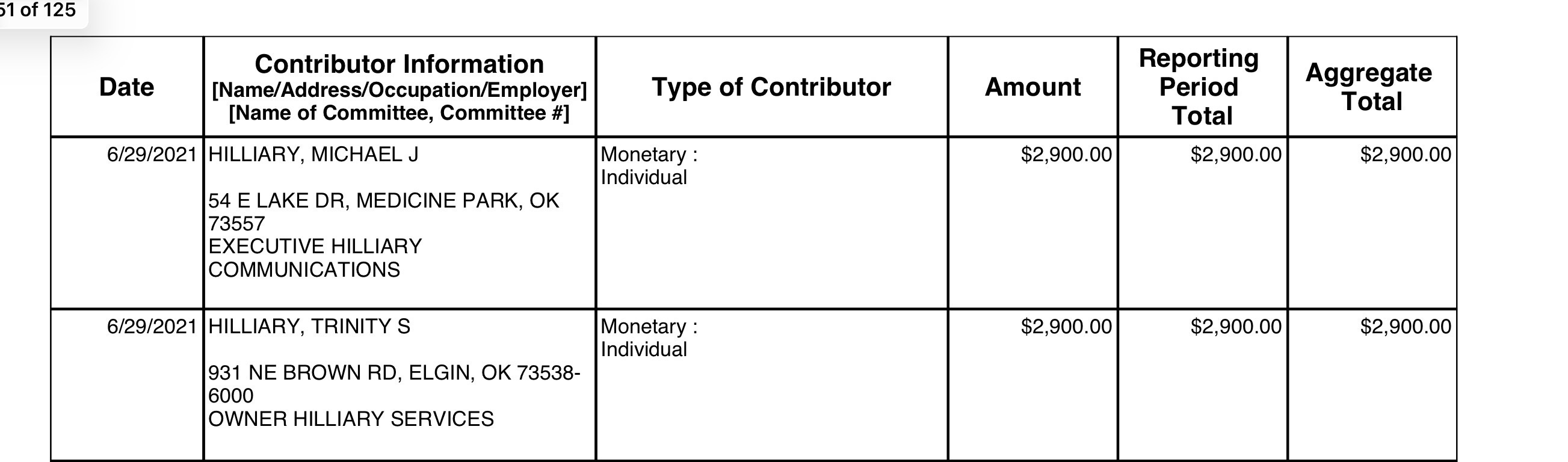
But the sequence does not stop there. By 2024, companies connected to that same network were receiving major public funding through broadband programs. Then in September of 2025, Dustin Hilliary was elevated again, this time to Senior Advisor to the Governor. This is not a ceremonial role. It includes acting as a key negotiator with the legislature.
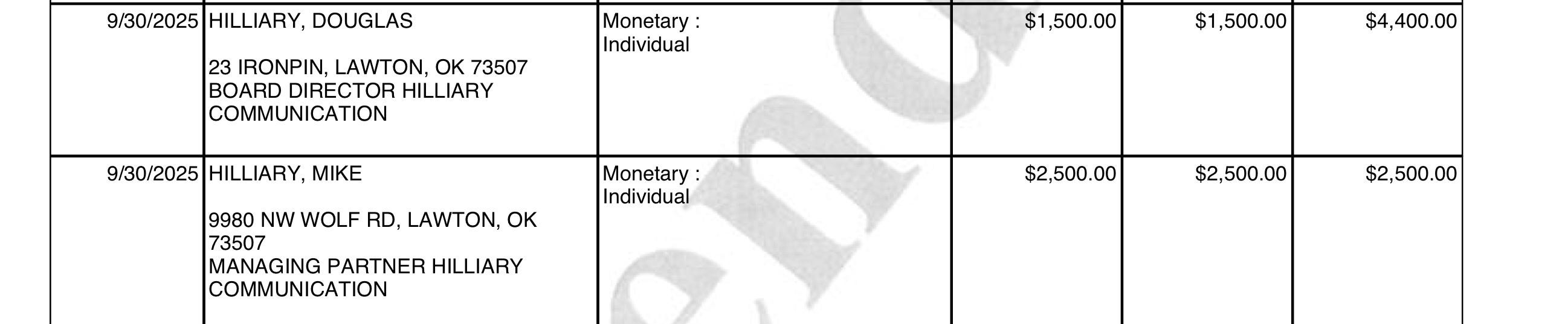
At the same time, the political activity continues. While Dustin had assumed an executive position, his family and business continue their political contributions. In 2025, Doug and Mike Hilliary donated to Kristen Thompson. Normally, this wouldn’t be important, but Thompson is not just another legislator. She sits in a leadership role connected to economic development through the LEADS Committee, one of the very places positioned to influence which companies receive incentives.
Loss of Transparency
Earlier, we discussed SB1447 and the Nondisclosure Agreement provision that was found within it. Here is where things get concerning. For a committee that was advertised as aiding in transparency and ensuring that tax payer dollars are put to the best use; this committee is anything from transparent.
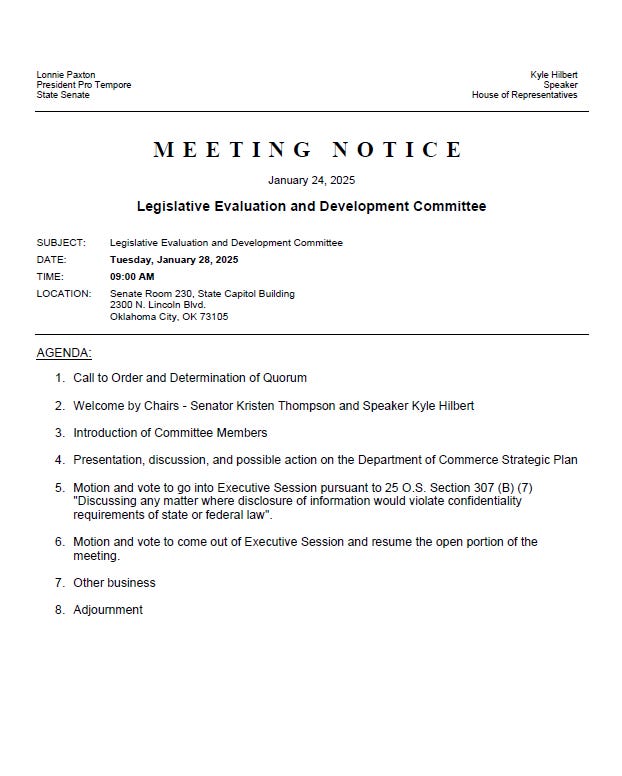
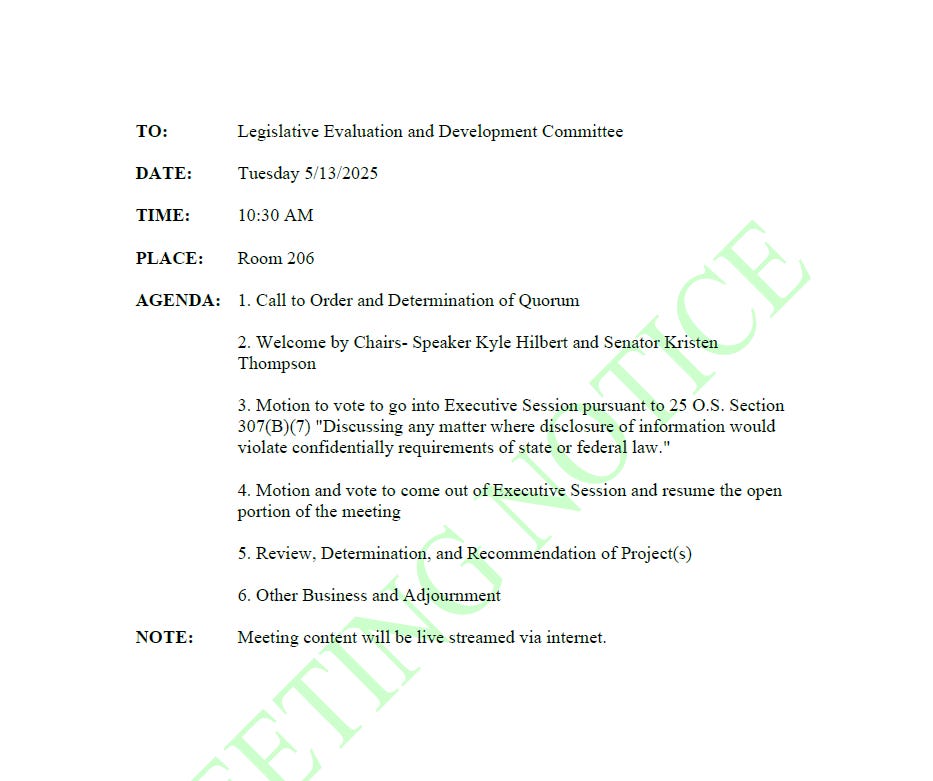
Since its inception, the committee which is co-chaired by Sen. Thompson and Speaker of the House Hilbert, it has had two meetings. One in January of 2025 and one in May of 2025. Now a normal committee is available to the public and open to public scrutiny. However, the committee that is discussing in which way taxpayer money will be divvied out in incentives, no scrutiny is available.
When you listen to the brief proceedings the majority of them are formalities before the Chairmen invoke 25 O.S Section 307(B)(7) and place the committee in what is known as Executive Session. This places them in a session where only those under the NDA or those allowed by the Chairmans are allowed inside and it further suspends audio and video recordings.
One would think, well maybe the minutes of the meeting would allow us to glean an insight into what projects are being discussed. Unfortunately, they are not helpful as they just saying that there was a motion to enter executive session.
What we are left with is no knowledge of what was discussed, what incentives died, why certain incentives made it through or what other options were made available.
An Adjacent Shift
Looking at the broader political structure, another shift occurs. In 2023, Governor Stitt’s campaign committee is terminated even though he still has time left in office. That could be nothing. Fundraising often slows when a governor becomes a lame duck. But that same year, a new entity appears: 46 Forward.
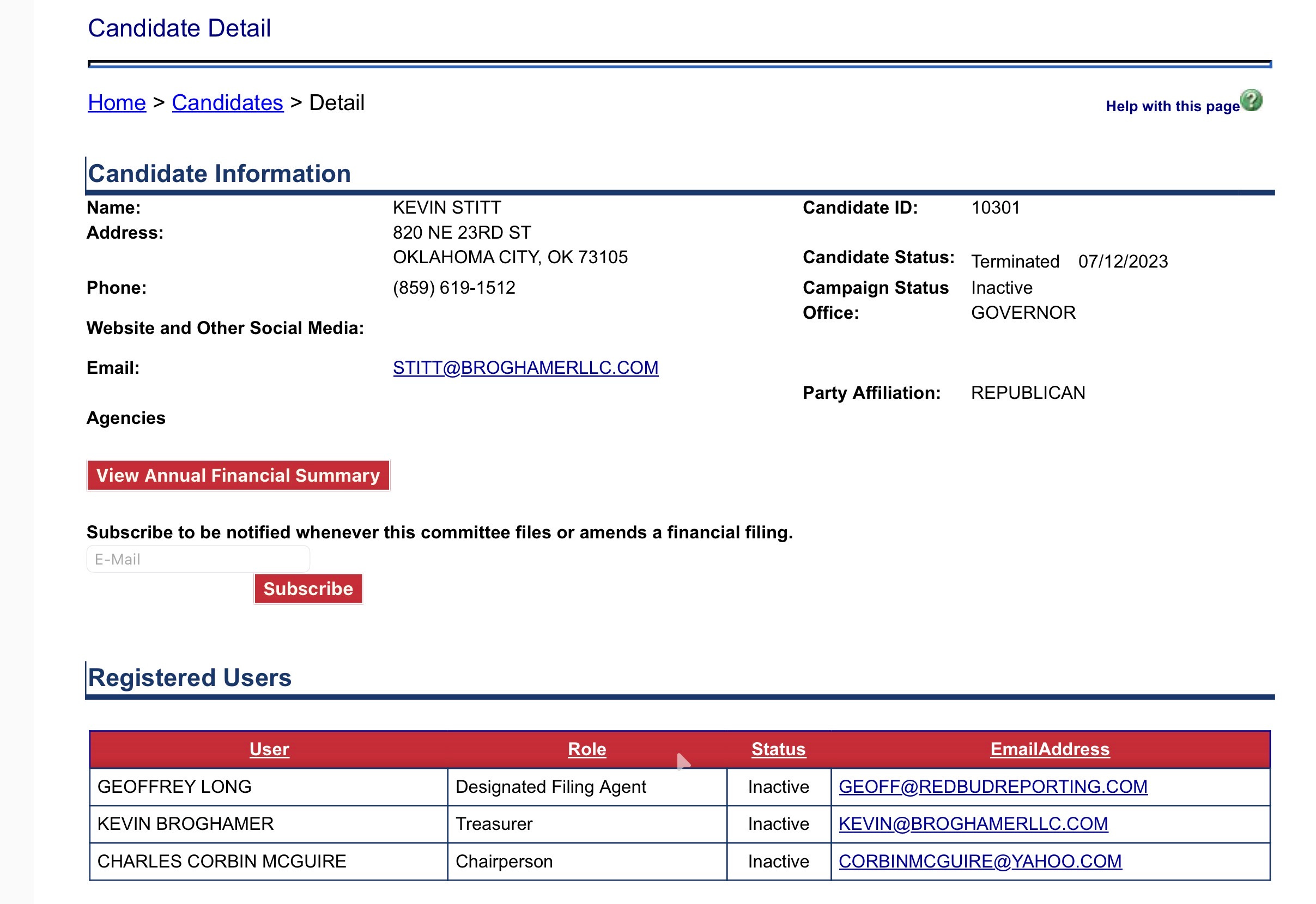
The individuals connected to 46 Forward are not random. They include, Donelle Harder, former chief political strategist, Romney McGuire, the spouse of Stitt’s campaign chair, and Richard Tanenbaum, who has also donated to Kristen Thompson. Campaigns may end, but political networks rarely do. They adapt, they rebrand, and they reorganize.
Beneath all of this is the consultant layer you are already familiar with. Victory Enterprises appears in both campaign spending and PAC activity. Kristen Thompson’s campaign has paid Victory more than $118,000. At the same time, Defend US PAC is paying Victory Enterprises and running independent expenditures, including more than $200,000 in media spending to a single candidate.
In a local Senate Race Defend US PAC paid Victory Enterprises in support of a JJ Francias, who also happens to be a CAMP client. The same race, the same side, just operating in different lanes. In another instance, Defend US PAC spent more than $200,000 supporting Drummond, who has paid CAMP more than seven figures.
This does not show formal coordination. What it does show is alignment. Campaign strategy and independent expenditure activity operating within the same ecosystem, reinforcing the same outcomes from different directions.
South Creek Group, LLC also fits into that same layer. Paid by the national super PAC and connected to House Leadership. If you remember from previous articles, one of South Creek Groups former partners, is Jake Parsons before he was elevated to Senior Advisor to the Speaker of the House in 2018.
Then there are the relationships. Dustin Hilliary serves as treasurer for Wolf PAC, which has made payments to James Martin Company. A designated filing agent for that company is Carly Farris, who works at the James Martin Company. That company is owned by Jenna Worthen, who is married to Trebor Worthen, a former business associate of Fount Holland, who is connected to the CAMP network. James Martin Company is also used by multiple members of the Oklahoma House.
At a certain point, this stops looking like separate entities. Companies connect to people, people connect through business, through marriage, through shared work, and through the same consultants and vendors. All of them appear somewhere near power. Near campaigns, near policy, and near money.
That is what stands out. Not any single connection, but the repetition. The same network appearing across public funding decisions, economic development policy, executive advisory roles, campaign strategy, PAC spending, and personal relationships.
This is not about proving something illegal. It is about recognizing a structure. Influence in politics does not require a written agreement. It requires access and proximity. When the same network is positioned across multiple places where decisions are made, the question becomes unavoidable.
Is that coincidence, or is it concentration?